
Art
Hieronymus Bosch’s Garden of Earthly Delights contains a hidden musical score painted on a figure’s body. Discovered and transcribed in 2014, the haunting melody creates an immersive way to experience Bosch’s 500-year-old masterpiece through both sight and sound.
Updated 01:19 pm EDT, Oct 14, 2026
Published 01:11 pm EDT, Oct 14, 2026
Photo Credits: Museo Nacional del Prado

Art
Hieronymus Bosch’s Garden of Earthly Delights contains a hidden musical score painted on a figure’s body. Discovered and transcribed in 2014, the haunting melody creates an immersive way to experience Bosch’s 500-year-old masterpiece through both sight and sound.
Updated 01:19 pm EDT, October 14, 2026
Published 01:11 pm EDT, October 14, 2026
Photo Credits: Museo Nacional del Prado
Hieronymus Bosch’s Garden of Earthly Delights contains a hidden musical score painted on a figure’s body. Discovered and transcribed in 2014, the haunting melody creates an immersive way to experience Bosch’s 500-year-old masterpiece through both sight and sound.
Updated 01:19 pm EDT, October 14, 2026
Published 01:11 pm EDT, October 14, 2026
Photo Credits: Museo Nacional del Prado
Experiencing art is multifaceted, and a single masterpiece can be interpreted or felt differently throughout the centuries. Few works demonstrate this dynamic better than Hieronymus Bosch’s The Garden of Earthly Delights, one of his many triptychs that has survived over the centuries. This painting had hidden music in plain sight that no one even bothered to compose until 500 years later. Listening to this eerie tune while standing directly before the triptych elevates this masterpiece into a chilling, immersive historical event; it is the full bottom experience that very few know about.
Hieronymus Bosch was a Dutch Renaissance painter from the 15th century and known for his macabre illustrations with religious connotations, typically executed with oil on oak wood. His artworks are predominantly themed around the sins of the earthly flesh, accompanied by ominous yet nightmarish depictions of hell or the consequences of these sins. Bosch’s works remind me of Dante Alighieri’s journey through the 7 layers of hell, sprinkled with Salvador Dali’s surreal characters. It’s quite something to marvel at.
There is little known about his life, but this Renaissance painter gave us some of the most fascinating and yet disturbing works that have survived throughout the centuries. Generations of scholars have tried to dissect and decipher what each painting meant with their own perspectives. Some theories of sorcery and others of religious breakdowns. But none considered the actual physical music hidden in the details of one of his paintings until 2014.
The Garden of Earthly Delights is housed in Spain’s Prado Museum, on the ground level, on display in Room 56A. This triptych, along with other works by Bosch, is part of the museum’s permanent collection.
The Garden of Earthly Delights is comprised of three highly detailed panels. The left panel depicts the biblical characters of Adam and Eve in the Garden, the middle panel is the earthly plane where we see the sins unfold, and the right panel is the descent to hell with an assortment of demons; this is the panel of importance.

This masterpiece is littered with intricate details. One common thing we notice is the bizarre musical instruments used throughout. And as your eye moves over to the third panel, you’ll see a character hidden behind an oversized lute, face down, in the nude with music notes on his buttocks. But let’s pause here.
A couple of months ago, I was working on a separate article about how art and fashion have relied on each other over the centuries, using different art periods for examples. As I was connecting how Renaissance art was still being utilized for inspiration today, with the late Alexander McQueen’s last collection, Angels and Demons, I learned he had used Hieronymus Bosch’s art in his mood boards. And of course, wanting to refresh my memory about McQueen’s last collection and Bosch’s works, I found myself way off course, but in a good way.
I had come across a link to a lighthearted NBC exposé about a student who composed the musical notes of Bosch’s nude character.
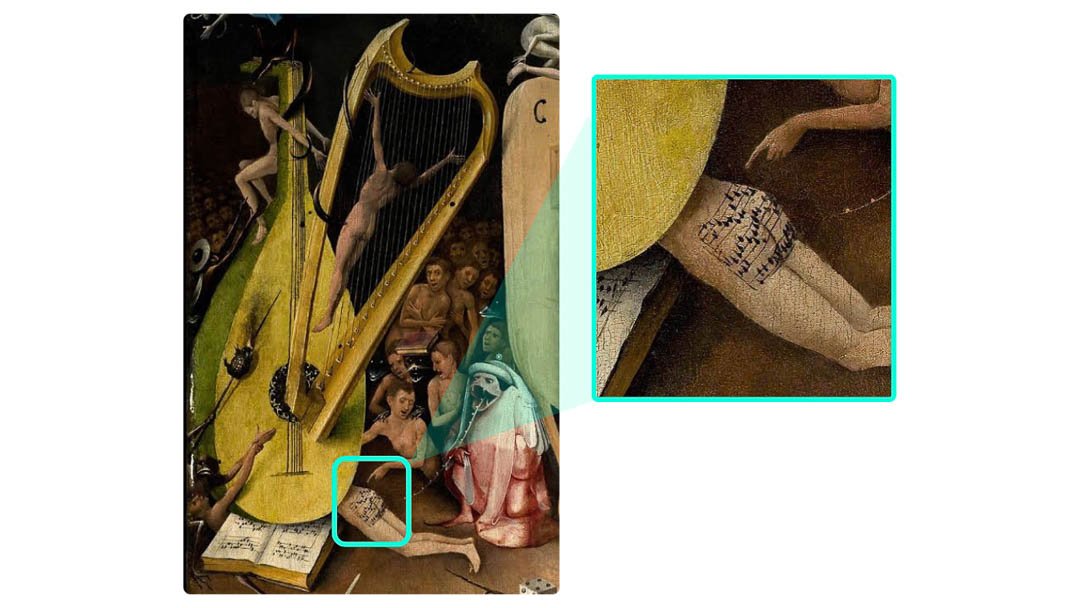
As it turns out, back in 2014, a group of art students at the University of Oklahoma were examining Bosch’’s The Garden of Earthly Delights late one night. In that group, there was one student who was a music major, Amelia Hamrick. She had noticed the tiny detail on the character’s backside, transcribed and recorded this score as a joke, calling it Butt Music. She then posted it on her blog, and of course, it went viral, with several art and major news publications like CNN’s Anderson Cooper’s ‘RidicuLIST’ covering it. The song is less than 25 seconds, but has historically impacted the painting to date.
While scholars had recognized the musical notes, Hamrick was among the first to actually play the melody as painted, giving voice to a slight joke half a millennium old. Others have followed in her footsteps, and these renditions can easily be found with a quick online search.
This backstory couldn’t have come at a perfect time. I was gearing up to head over to Madrid to meet up with some colleagues. While there, I had planned to pop over to the Prado Museum again, but this time with a mission––to listen to that exact tune while standing in front of this large triptych. I wanted the full bottom experience, no pun intended.
Standing before the triptych with earbuds in, I pressed play, and the transformation was immediate. Hearing the eerie tune while carefully absorbing all the elements and details across all panels sent chills all over my body. It felt less like viewing a masterpiece and more like a haunting animated experience in real-time. I even tried the other musical variations created after the initial discovery, each offering a slightly different, equally unsettling sensation.
While many articles have been written about the musical discovery, and social media reels “rediscovering” it, I have yet to come across any evidence of people actually applying the two in real time.
Anyone can apply an ominous, haunting melody to a painting; we see this in film all the time. But what makes this encounter momentous is that music was written on the panel itself, in plain sight, elevating this 500-year-old masterpiece both historically and audibly.
As a huge Renaissance art enthusiast, I once again found myself going back to this period, but not intentionally; a full-circle journey from art to fashion to music, right into Bosch’s hell. Since the musical discovery, pairing the tune with the visuals and experiencing it in real time is an opportunity one simply cannot miss.
It is also something that most art historians would truly love to experience themselves. It will surely alter future contexts about Bosch’s works and perhaps impact the scholarly community, whoever decides to embrace this challenge. Personally, this piece is proof that historical masterpieces continue to evolve over the decades and, with fresher perspectives from different sectors, allows us to explore the possibilities of any historical painting.

With a Bachelor’s in Studio Art from the University of South Carolina and a Master’s from the Miami International University of Art & Design—enhanced by studies in Italy—Michelle has expanded into an international artist, founded Arthesive.com, and continues creating, exhibiting, mentoring, and contributing to the global art community.
Get the latest fashion, culture, and art updates, including magazine releases release parties
Sponsored Content


