Fashion
Creative director Alfonso Pérez is transforming Angel Schlesser through his emotionally charged Liturgia collection, trading structural comfort for beauty.
Updated 10:24 am EST, February 25, 2026
Published 02:02 am EST, February 25, 2026
Featuring: Alfonso Pérez
Creative Director: Carlos Marán
Photography: Maria Novo
Creative director Alfonso Pérez is transforming Angel Schlesser through his emotionally charged Liturgia collection, trading structural comfort for beauty.
Updated 10:24 am EST, February 25, 2026
Published 02:02 am EST, February 25, 2026
Featuring: Alfonso Pérez
Creative Director: Carlos Marán
Photography: Maria Novo
There are runway shows that present clothes, and there are others that unfold. Angel Schlesser’s shows, under the creative direction of Alfonso Pérez, belong firmly to the latter. At his latest presentation, Liturgia, shown during the last edition of Mercedes-Benz Madrid Fashion Week, I did not feel like I was watching a fashion show. I felt like I was being carried through it. There was rhythm. There were pauses. There was tension and release. Everything felt intentional and never forced.
“For me, a runway show is not a random succession of clothes,” Alfonso tells me. “I try to tell a story. I want people to understand it and feel it, whether they like it or not. I want it to move them.” That insistence on structure, on progression rather than accumulation, is what makes his work feel closer to composition than presentation.
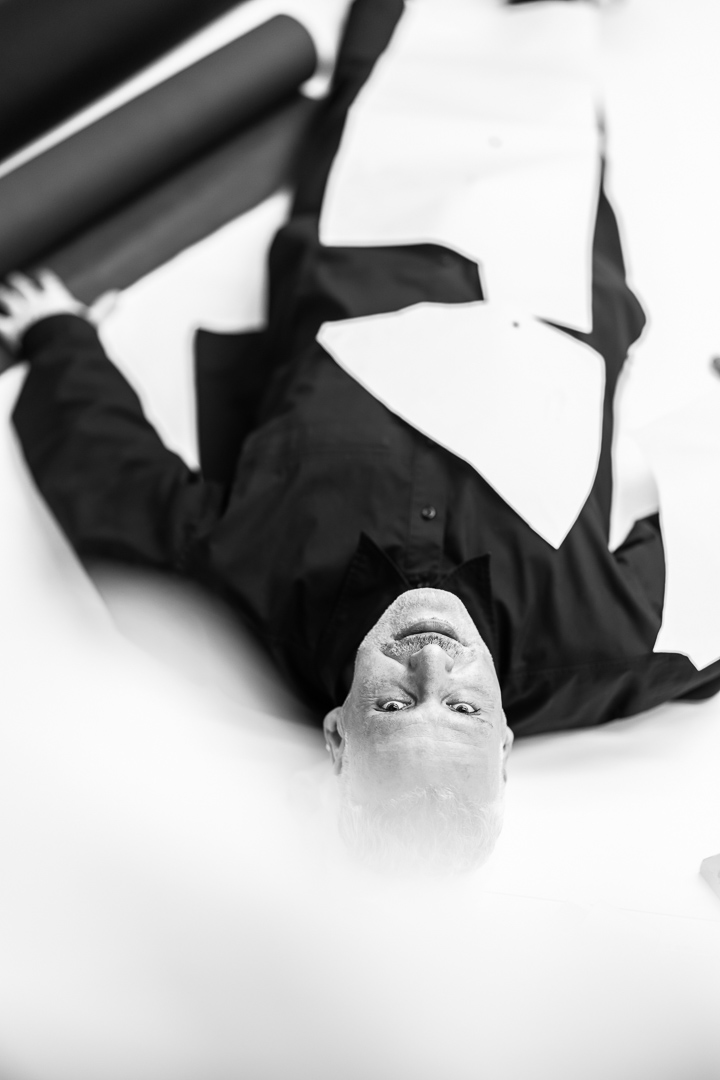
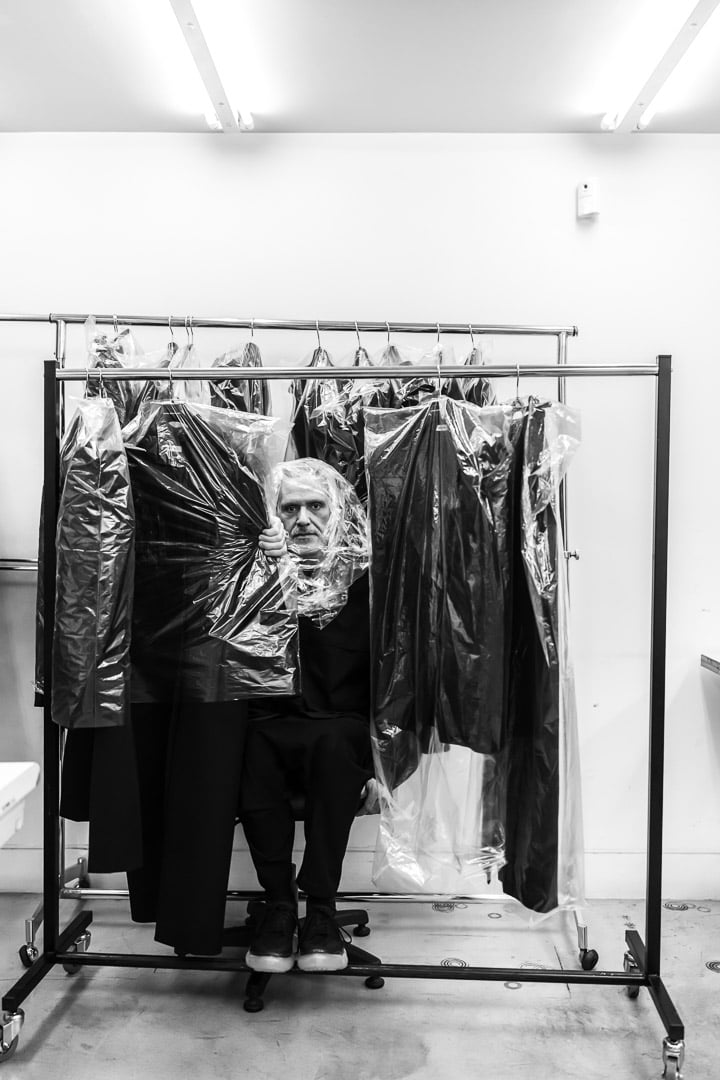
A native of Asturias, with a background in art, bridal, and precise tailoring, he is now at the forefront of Angel Schlesser, where he is responsible for its creative direction and for some of the most impactful runway presentations I have seen in recent years. Alfonso does not simply design collections. He conducts them. Each element, garments, light, music, movement, enters at the right moment, holds its place, and then makes room for what comes next.
“In the end, it’s like a symphony,” Alfonso says. “Everything has to be tuned with the means we have so that it can be dignified. There’s no magic. It’s many hours of being on top of everything. I want my collections to move something inside people. To make them think. To make them uncomfortable, to make them feel something even if they don’t like them.”
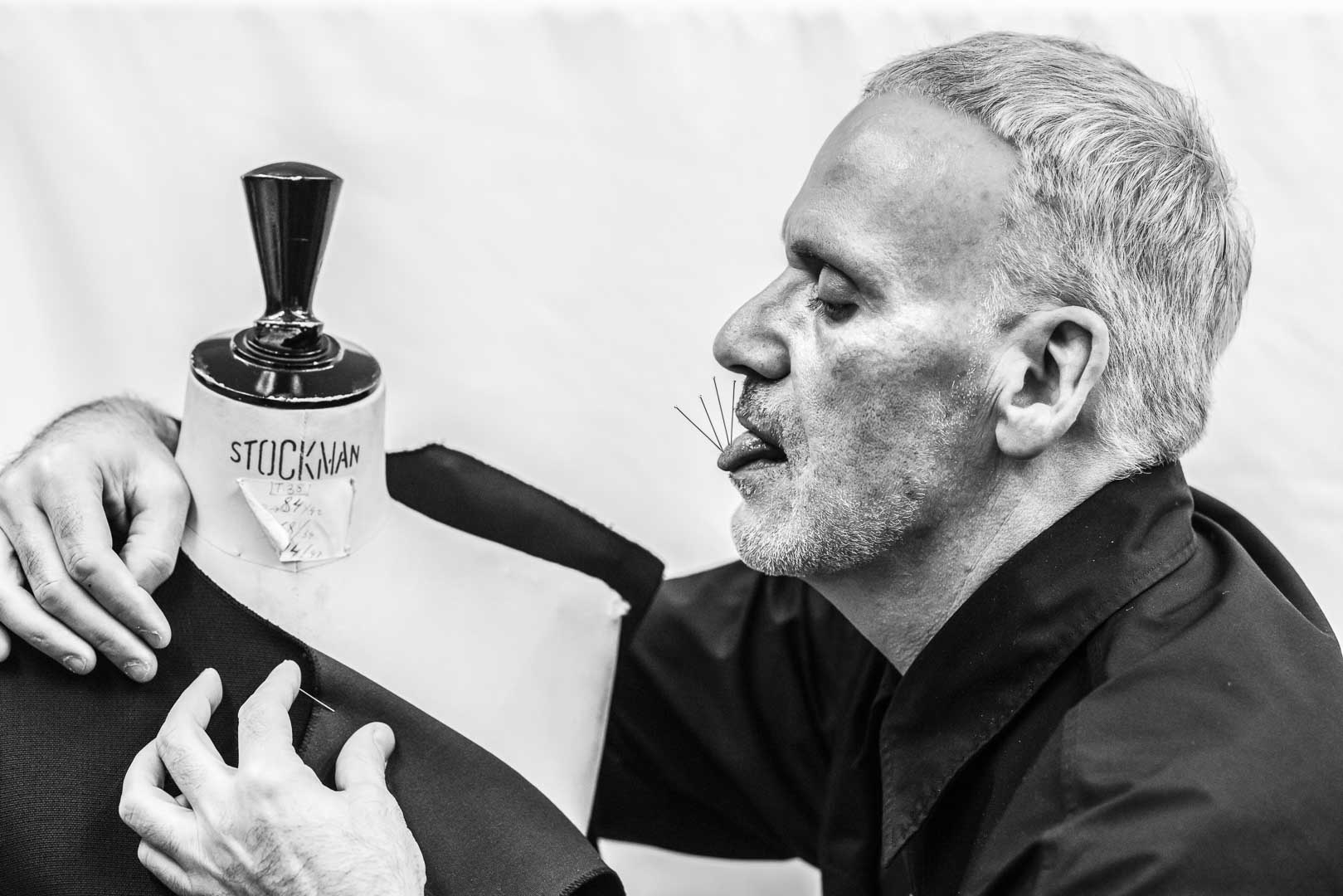
What allows that level of orchestration is not spectacle, but craft. A craft understood as discipline, as the pursuit of practice and knowledge. As physical intelligence accumulated over time. “Everything carries weight,” he explains. “For example, ironing. Ironing matters. I once spent an hour ironing a dress so I wouldn’t crush the fabric, so the hem would fall properly, so the garment could speak.”
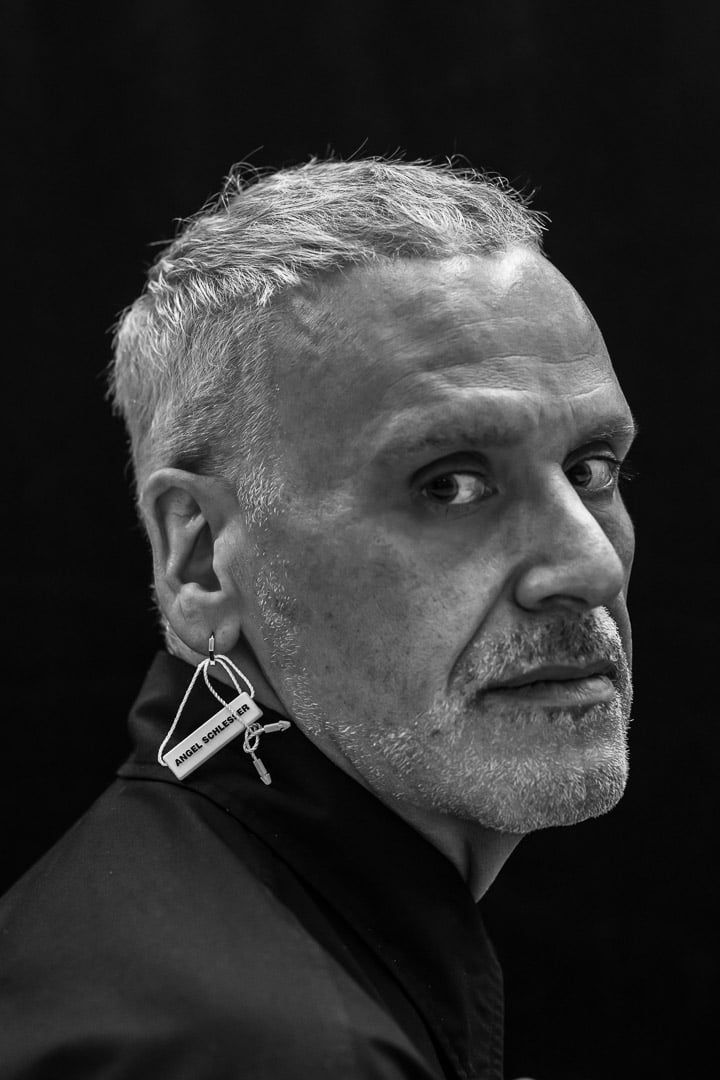
For Alfonso, intuition is inseparable from technique. “You have to know how to touch the garment. How to place your hand inside it. How to read its weight. Use the iron when it needs it, lift it when it doesn’t. Above all, it depends on the material. Not all fabrics can be treated the same way because each one speaks differently. The fabric speaks to you.” That conversation with material begins long before the runway. “I go to our warehouse and I begin by talking and feeling the fabrics. I need to understand how they work, how they fall, how they’ll respond if I want something languid or if I want volume. I’m very manual.” He doesn’t source new materials for his collections. “We don’t buy fabrics for the collections. I use what was left from previous years. We have a huge archive of beautiful materials.”
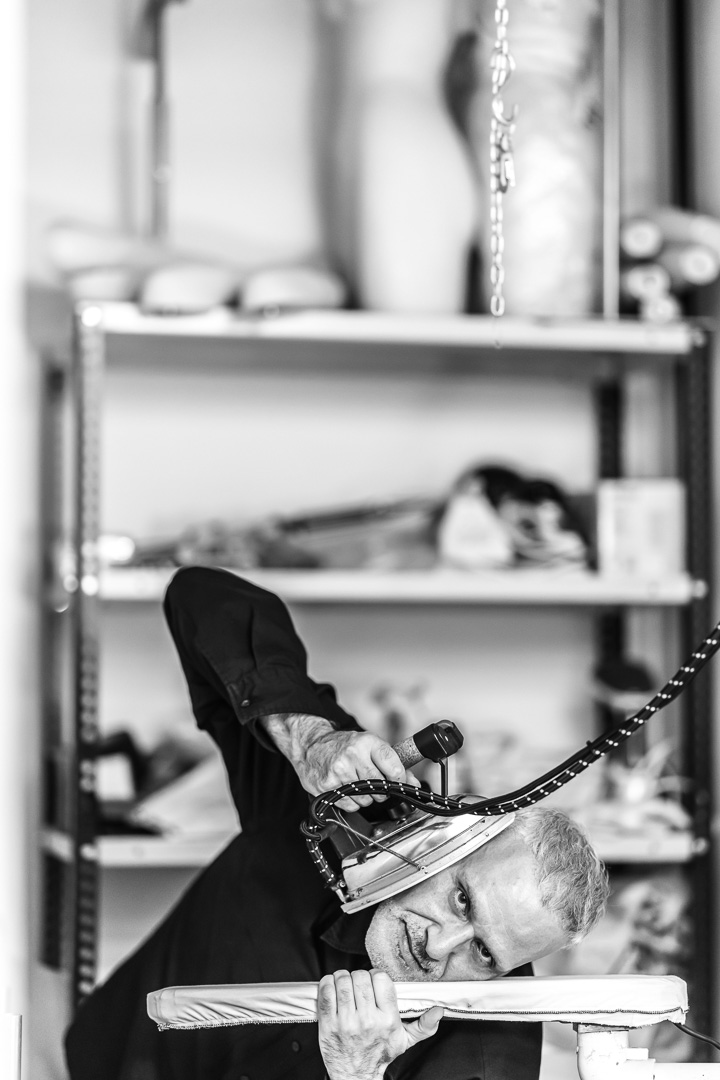
Structure, too, is built by hand. “I give a lot of importance to the upper body, to the shoulders, because that generates everything. It defines the entire structure. I do it this way because I’ve spent many hours in the atelier, learning the craft. I had no money, so I realized that either I did things myself or nothing would happen.” In Alfonso’s work, control is earned. It comes from repetition, from limitation, from having had to do everything himself. From a lifetime of developing a craft under the lens of precision. All that time moves from Alfonso’s hands into the garment. And it lives there, visible, holding the piece together. But for Alfonso, control does not end at the garment itself. It extends far beyond it.
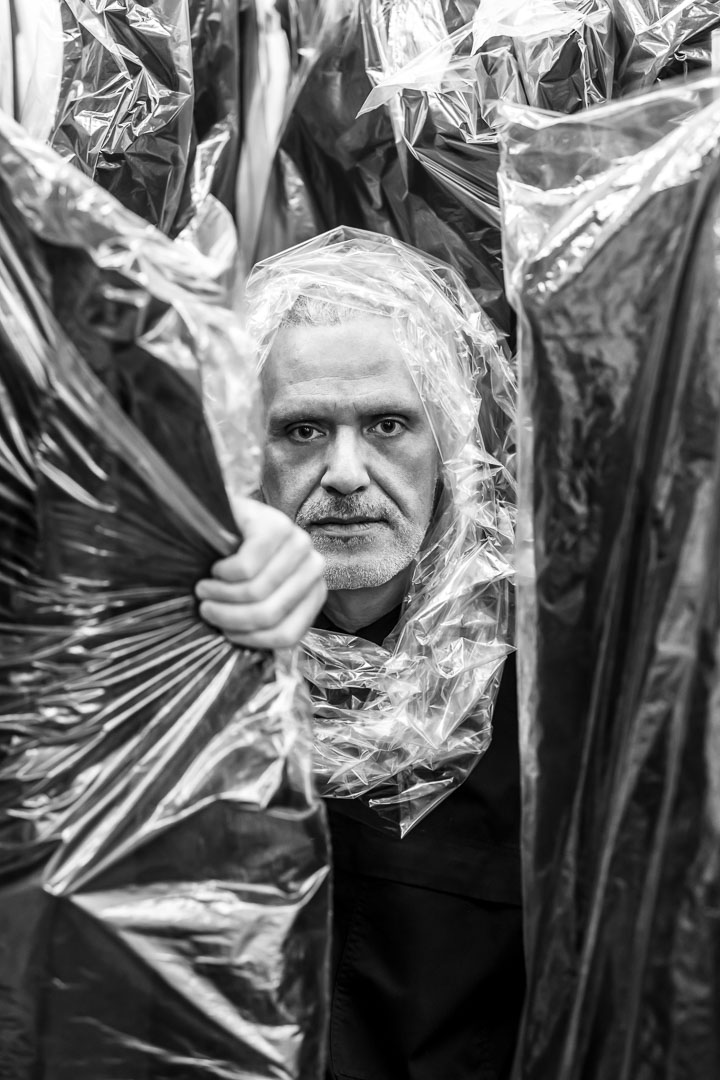
For him, a runway show is not a neutral container where clothes simply appear. It is an environment that must be carefully constructed, emotionally and physically, so his work can exist fully. “A runway show is models, music, lighting, and clothing that speaks,” he says. For him, nothing is secondary. Everything participates. Darkness, in particular, plays a crucial role. “I love darkness because it gives prominence to the models.” By removing excess visibility, attention sharpens. The eye slows down and the model on the runway becomes the focal point, not the spectacle surrounding it. Control, in his practice, is also built through relationships. “I like treating people well, because they’ll defend your work, and it shows. The atmosphere matters.” For Alfonso, the emotional climate backstage is as important as the one experienced by the audience. The runway is not only a performance. It is the final expression of a collective state, built through respect, trust, and shared commitment.
Liturgia was born from that place of control and belief, from a process that unfolded less like design and more like ritual. It emerged from a moment of tragedy and collective loss, charged with the visual language of sanctuary and religious iconography. “Liturgia was born because I was watching the Pope’s funeral, and it struck me as a moment in history of immense beauty,” Alfonso explains. “Everything was so organized that I thought, this is an absolute haute couture show. The order, the hierarchies, the heavily embroidered robes, the gold. And within that setting, St. Peter’s Square, the Vatican, the procession, how they brought in the coffin and formed that line. I thought, this is pure, uncompromising haute couture.” That moment of order and ceremony became the starting point. From there, the collection began to shift. “The first part came from that, and then I started painting, dirtying the fabrics like a madman in a summer courtyard, barefoot, coming out of it a mess. And I didn’t care.”
What followed was a period of profound search. “I asked myself how to go from there. I’m lucky enough to have around me people far more learned than I am. I sent images of the painted fabrics to a friend I love very much, whom I’ve known for many years. She studied Fine Arts and is now a professor. She said to me, ‘this is marvelous. You’ve arrived at Informalism. You should go to Cuenca, to the Museum of Spanish Abstract Art.’” Alfonso went to Cuenca with a notebook and a pencil. “I spent six hours drawing. I realized there were patterns in those paintings and I thought, let’s see what all these artists have to tell me.” The visit marked a turning point. “I decided that I had to pay homage to Spanish abstract art and create this liturgy, which deep down is about the processes of couture and about these artists who have inspired me my whole life.”
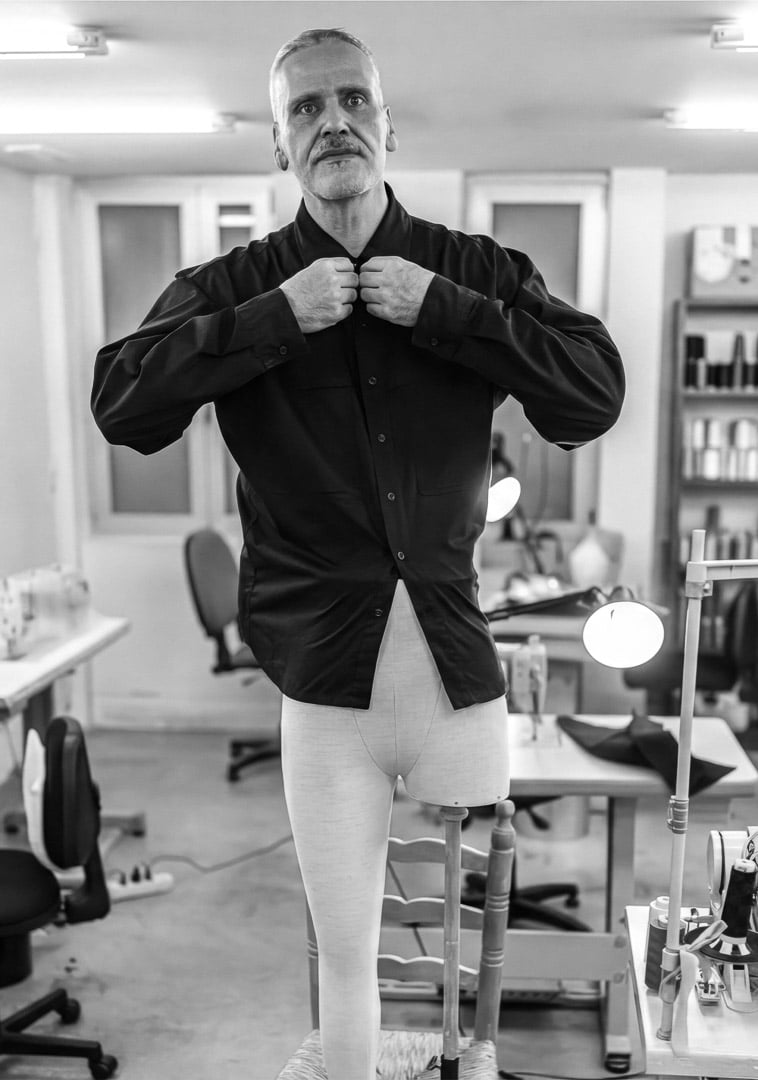
“And that’s what I did. Then I went to sleep in a convent, for further mortification,” he adds laughing. “And there I realized I had the argument of Liturgia. The white part, the habits, the celestial. The earthly part, which is painting, which is abstract art. All these armors, these huge volumes that deep down are also a cry against all this human garbage we’re living through, and which conceal a person, a body, a soul, a life that feels and suffers. And then I finish with this black part, which is mourning, the requiem and transformation.”
The collection was not guided by a rigid system. “I try to have a method. I really try. But method and I don’t get along very well,” he admits. “Inspiration hits suddenly. I’m very distracted, but at the same time, very observant.” Beauty, for him, was never the objective. “It doesn’t have to be beautiful. It can be something disturbing that catches attention. What matters is communicating something.” That insistence on communication runs through the entire collection. “Trying to communicate something is very important,” he says. “Through clothing, telling what’s happening to you or what the world is living. For me, context matters, even if it seems like what you’re saying is ‘nothing.’” Listening to the story of Liturgia unfold, I could almost see his process in motion. I could hear it too. The slow tempo of drawing. The sharp interruption of paint hitting fabric. The repetitive, disciplined rhythm of hands working material into form. Like a composition built through tension, silence, and release, the collection revealed itself not all at once, but in time. That rhythm makes it impossible not to think about where this language comes from.
To understand the present of Angel Schlesser, you first have to understand its origins. The house was built on restraint, precision, and clarity, but it was in the Spain of the 1990s that this language fully consolidated. Its minimalism came to represent structure, order, and control. It was a vocabulary of balance and proportion, one that trusted cut over ornament and discipline over excess. The brand established itself by doing something very difficult: building a coherent system that made sense and sustaining it with consistency over time.
In music, that kind of foundation has a name. Joseph Haydn was the composer who built structure before expression became personal. He did not seek to disrupt or provoke. He sought to organize. To give form to chaos. To establish proportion, balance, and clarity so that meaning could unfold within a stable framework. Haydn composed for continuity. His genius was architectural. He standardized the symphony not to limit expression, but to make coherence possible.
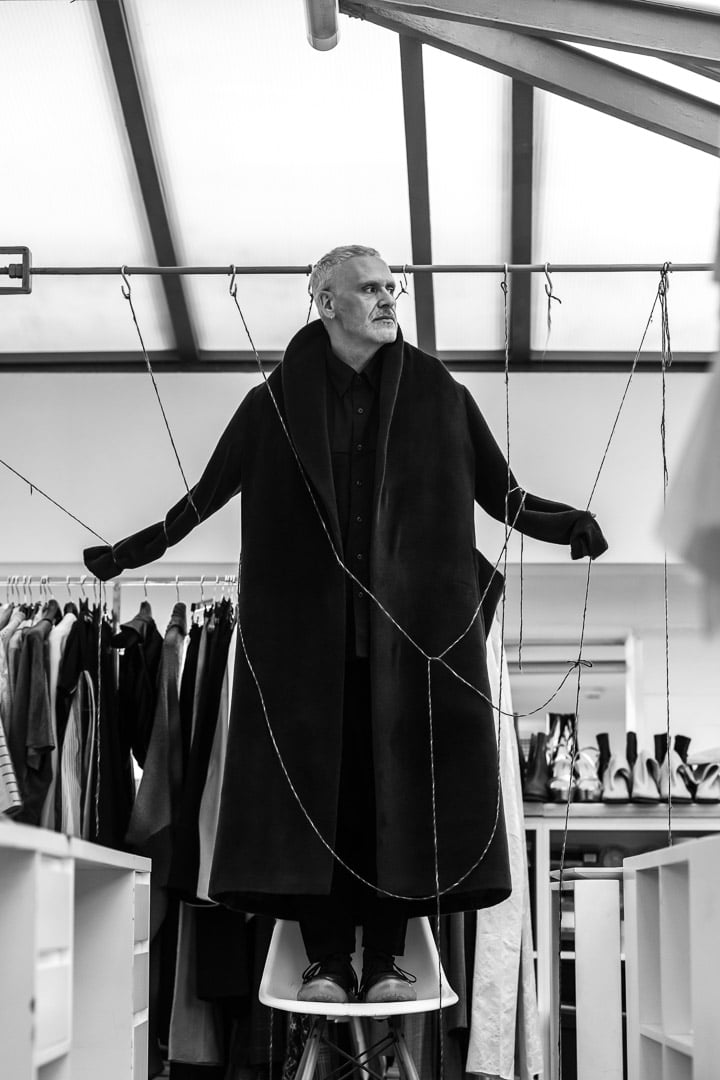
Haydn’s work created a system strong enough to endure. Tension was measured. Release was precisely timed. Everything had its place. Nothing was accidental. The result was a language that could be inhabited by others long after him. In many ways, Angel Schlesser’s origins mirror that same impulse. The house was built on restraint and proportion, on discipline as a form of elegance. It established a visual grammar that allowed the brand to speak clearly and consistently. Like Haydn’s symphonic form, it provided a structure that could hold repetition, refinement, and longevity. It was never about noise. It was about balance.
A system that works too well can begin to harden. What was once structure can become expectation. What was once clarity can turn into prescription. Over time, the past stops being a reference and begins to exert gravity. This is where time becomes complicated. Not because the system failed, on the contrary. This happens because it succeeded. We all know fashion does not exist outside of the present. Each era demands its own vocabulary and its own urgency. And it is precisely at this intersection, between a system built to last and a world that refuses to stand still, that evolution becomes unavoidable. And all systems, no matter how well built, eventually face a question. Not whether they were right, but whether they are still alive. Alfonso is explicit about this tension. “I try to create a code that walks with the time we are living,” he says.
And when a system reaches that point, history shows that it does not evolve through refinement alone. It evolves through disruption that comes from within. In the world of music, that moment arrived with Ludwig van Beethoven. Beethoven inherited Haydn’s structure fully formed, but he refused to remain inside it. He took the symphony and turned it inward. What had been balance became urgency. What had been proportion became tension. Time itself changed. His compositions demanded attention, patience, endurance. They unfolded not as elegant sequences, but as lived experiences marked by struggle, obsession, and transformation.
Alfonso Pérez enters Angel Schlesser at a similar moment. He enters the brand to push it forward. Like Beethoven, he does not reject structure; he relies on it. But he bends it in pursuit of something deeper. Emotion. Presence. Meaning. His work does not ask to be remembered as a reference to the past. It insists on being experienced in the present. There is another reason why the parallel with Beethoven feels unavoidable. Not because of rebellion alone, but because of renewal. When Alfonso Pérez stepped into Angel Schlesser, he did so at a moment when the house risked being remembered more than experienced. Its language was intact, its codes recognizable, but its presence had grown quiet. What followed under his direction was not a return to what once was, but a reactivation. A bringing back into the present.
Confirming this may be Angel Schlesser’s best kept secret: that the brand’s current vitality, its renewed visibility, and its emotional relevance are deeply tied to Alfonso’s determination to move forward. Even when the comfort of nostalgia would have been easier, his work does not trade on memory. It argues for evolution. And that insistence, more than disruption, is what has allowed the house to be felt again. This is where time reveals its true role. Because in the end, time is not the enemy of tradition, it is actually its proving ground. Systems are built so they can last, but they remain alive only if someone is willing to inhabit them fully, test their limits, and allow them to change. In music, that responsibility fell to Beethoven. Not to erase what came before him, but to make it resonate differently. To carry structure forward by charging it with urgency, emotion, and lived experience.
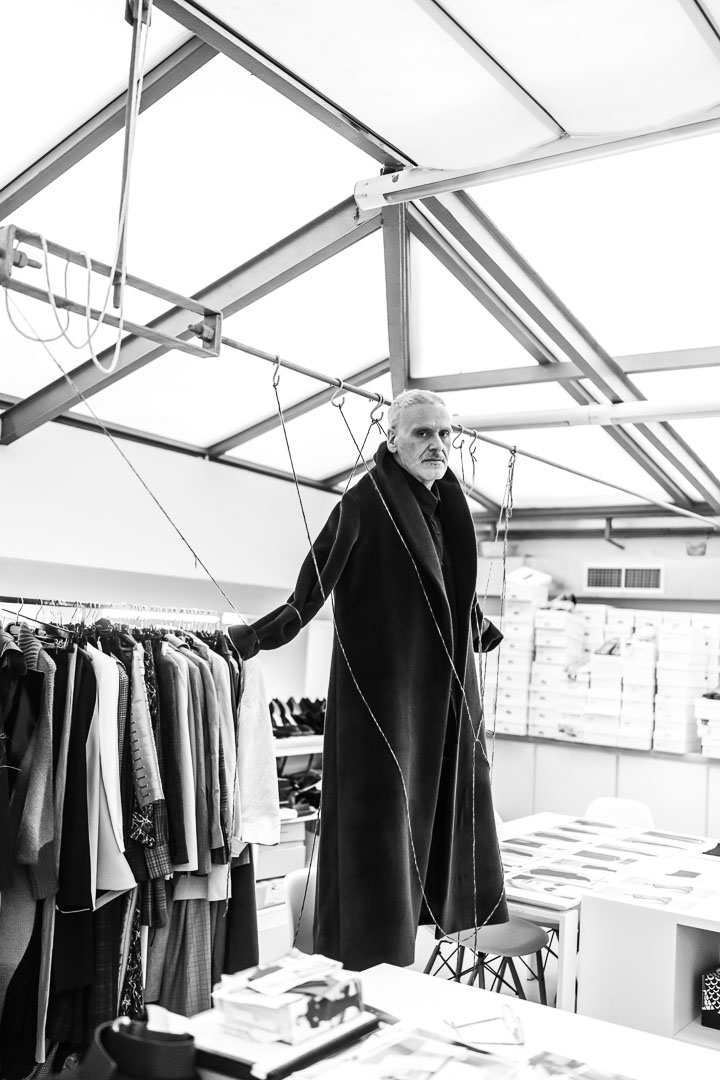
Alfonso Pérez is doing the same for Angel Schlesser. He is not dismantling its language; he is reactivating it. Allowing it to breathe in the present. Allowing it to unfold rather than repeat itself. Beethoven did that for the symphony. Alfonso is doing it for Angel Schlesser. And in both cases, what emerges is not rupture for its own sake, but an unfolding shaped by time. An unfolding like the Liturgia runway show: deliberately, patiently, and very much alive.

Fashion Designer and Professor, Mena believes that fashion completely transcends the surface and the most important is how one feels rather than anything else. Fashion is really about how empowered one becomes by it. She channels vibrant flares of vintage fashion and dreams of contemporary twists, inspired by her own life and travels.
Get the latest fashion, culture, and art updates, including magazine releases release parties
Sponsored Content