
Culture
An exploration of Georgia’s 8,000-year wine heritage, highlighting its indigenous grape varieties, traditional qvevri winemaking method, and the blend of ancient practices and modern innovation that continues to shape its wine culture.
Updated 11:50 am EDT, Jul 21, 2026
Published 05:41 pm EDT, May 8, 2026
Photo Courtesy: National Wine Agency of Georgia
Culture
An exploration of Georgia’s 8,000-year wine heritage, highlighting its indigenous grape varieties, traditional qvevri winemaking method, and the blend of ancient practices and modern innovation that continues to shape its wine culture.
Updated 11:50 am EDT, July 21, 2026
Published 05:41 pm EDT, May 8, 2026
Photo Courtesy: National Wine Agency of Georgia
Vinexpo Americas 2026 took over the Miami Beach Convention Center on April 29 and 30, bringing together one of the largest gatherings of the wine and spirits trade in the Western Hemisphere, with Miami as the natural crossroads of North, Central, and South America and the Caribbean.
This year Vinexpo Americas 2026 gathered 1,659 participants from 53 countries, including wine and spirits producers, importers, distributors, buyers, and industry experts. This show was absolutely essential for every buyer looking to source the finest wines from around the world and have direct access to winemakers and distributors, all in one place.
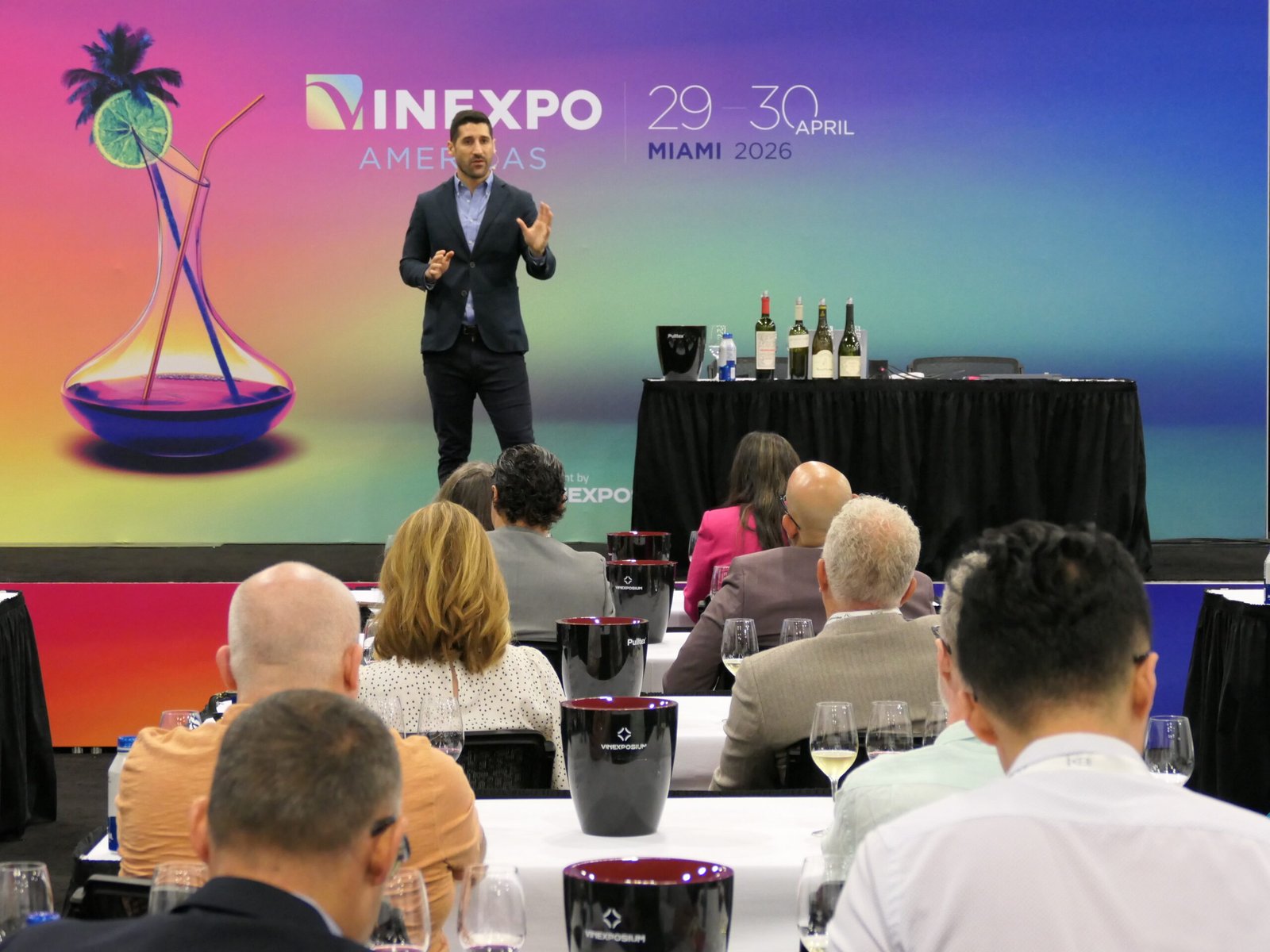
Based in Paris with their flagship international Wine Paris exhibition, Vinexposium’s is focused on building meaningful relationships that turn into successful and mutually beneficial business through every aspect of the winemaking industry, from winemakers, importers, and wholesale buyers, Vinexpo Americas is key as a global extension for the industry. From direct meetings, wine tastings and curated Masterclasses on topics such as market trends, consumer insights and business solutions, Vinexpo Americas 2026 had it all.
While attending the expo, I had the opportunity to visit and taste the wines of Georgia. Though not as well known to the average consumer in America, the country of Georgia is certainly not new to winemaking. It is embedded in their identity. In fact, archaeological evidence shows that Georgia has a history of making wine for 8,000 years, meaning it is the birthplace of wine according to scholarship. Winemaking is tradition; it is ingrained in the culture, in family life, in every home. Whether in the countryside or in an urban home, the family is making wine. Winemaking and Georgia are synonymous.
Where Europe and Asia intersect, sitting along the eastern border of the Black Sea and nestled between the Greater Caucasus on the north and the Lesser Caucasus on the south, Georgia has quite an expansive climate and topography. From holding Europe’s highest mountain range and peak at 18,500 ft. to the volcanic plateaus and lush meadows on the south, and the central lowlands to the mineral-rich seaside, Georgia has a bit of everything. Being similar in area to West Virginia, Sri Lanka or Latvia, it is quite easy to see all the regions. In this relatively small country, there are 10 distinct winemaking regions and 30 Protected Designations of Origin. Georgia truly is a condensed fertile land perfect for the grape.
Georgia’s climate goes from one extreme to the next. Depending on what region you’re in, it could be humid subtropical, desert-like, volcanic, or alpine. You’ll also find the well-known limestone cliffs and caves that are due to the mineral rich deposits carried along by its rivers and streams. With its beautiful array of terrains and climate, Georgia is perfect for growing grapes and allowing winemakers to make a plethora assortment of wine and spirits. With more than 500 indigenous varieties of grapes that accounts for one-sixth of the world’s total grape varieties, Georgia has a unique position where endangered and rare grapes can be found. Of these 500+ varieties, 40 are currently used commercially. Vine libraries can be visited at various vineyards as well as the main centralized vine library, the National Grape Collection, to sample, study, and understand them.
Over the 8,000 years there have been many historical markers, wars and conquests that have affected the country’s winemaking. You’ll find this history of Georgian winemaking mentioned throughout ancient writings. Unfortunately, during these various historical invasions, Georgians would be driven out of their vineyards, halting and sidetracking the winemaking traditions. Luckily, all was not lost; the Georgians saved saplings so that they could be cultivated in new locations.
One such instability that was more recent was when family vineyards were seized by the Soviets in the 1990s. During this time, indigenous grapes were torn out and replaced with generic grapes; many vineyards were abandoned and grape varieties were lost. This caused a misconception about Georgian wine that led people to believe that they produced low quality wine.
This was not the true Georgian winemaking. It had been altered to something that was far from the ancient traditional wines of the country. While many grape varieties were lost, the Georgians came out from under that phase and are back to true Georgian winemaking. Because of this, there has been a great revitalization effort to find, identify, rediscover, replant, and protect the native varieties, including by the National Wine Agency. Today, there are more than 1,000 registered wineries and wine tourism has quickly developed, gaining even more interest in the ancient traditions of Georgian winemaking.
Though scattered throughout the country, the majority of vineyards are planted in the Kakheti region in eastern Georgia, making this the most prominent winemaking region. Of all the grape varieties, there are two that are most often used in winemaking, the Rkatsiteli grape for white and the Saperavi grape for red wine.
Rkatsiteli grapes can also be found outside of Georgia. These wines have a light body, are aromatic, breezy, and refreshing wines, perfect chilled for summer nights, and often have flavors of green apple, quince and white peach. The Saperavi grape is native to Georgia and is a more serious, strong wine. It is heavier and has quite a bit of acidity. Often, you’ll find flavors of dark berries, licorice, chocolate and spices in this wine. One very interesting fact about this grape is that it is one of the few teinturier grapes in the world, which is a rare grape that has both dark red skin and deep red flesh and juice, therefore making the wine very deep and opaque.
Georgian wine is also very well known for their amber wines. With more of an orange hue, amber wines are produced using white grapes but with the skins included in the fermentation process. Unlike white wine where the skins are removed immediately, this is not the case for amber wines. Leaving the skins in the batch during fermentation is what gives it its unique color, as well as the specific taste. It is quite dry due to the tannins it has and is a natural wine with no intervention in the process as it is made in the qvevri. It can often have an unfiltered appearance as well. Using traditional and modern techniques, winemakers create the perfect wines for every tastebud.
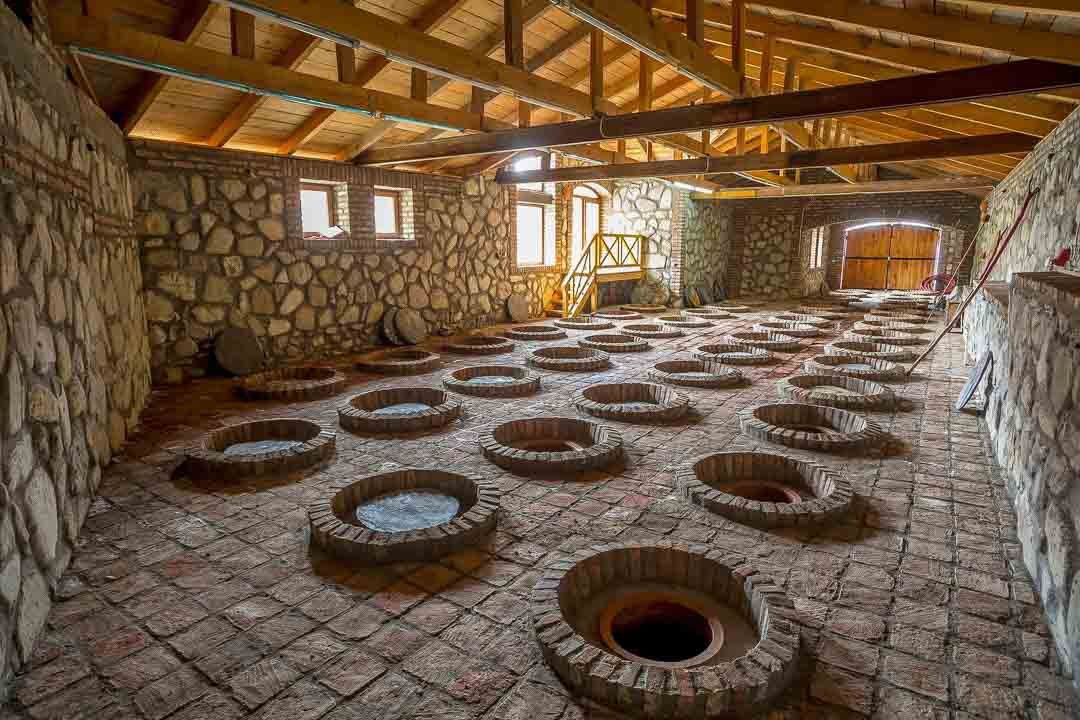
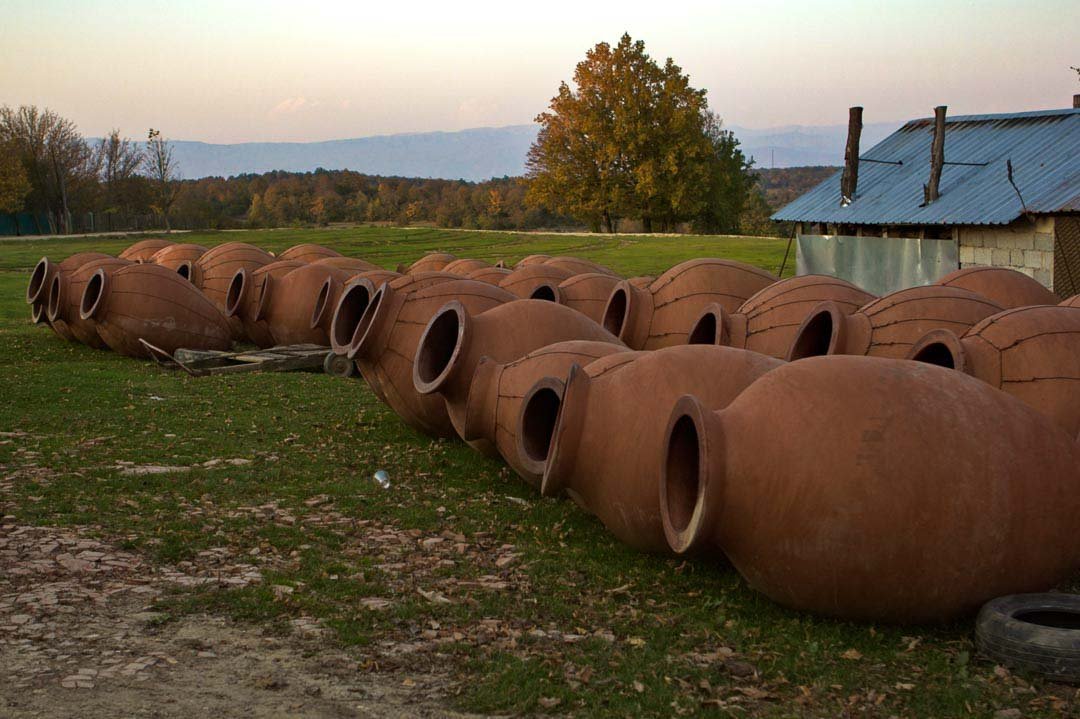
One particular aspect of Georgian winemaking that stands out from among others, is the country’s traditional winemaking process using qvevri. Qvevri are large egg-shaped clay vessels, large enough for you to stand in and often 1-1.5 tonnes. Still to this day, they are handmade by a few master qvevri-making families, which each takes about 6 weeks to make. They are buried underground with just their rim showing above ground to help maintain the temperature during fermentation and aging. The earliest qvevri found dates back to 6000 BCE. The use of qvevris allows winemakers to make wine with little to no intervention.
At every family home and winery across the country, the qvevris are buried underground in a wine cellar called a marani. A family has a smaller marani holding a few qvevri – enough to provide the family with wine and for any supra they have as they love having their family wine for it. Or they may have a few more, some for themselves, and minimal for commerce. They typically make enough wine in their qvevris to last them a year until the next harvest.
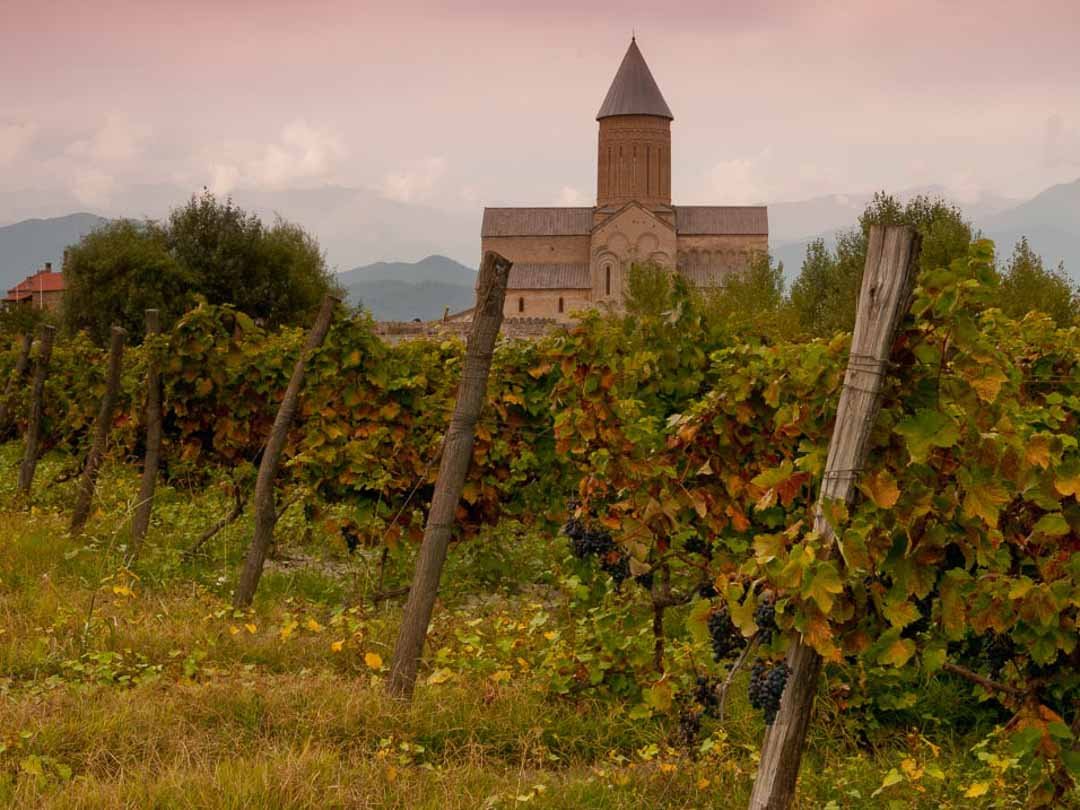
On the other hand, a commercial winery often uses qvevris that are 1.5 tonnes each, but some may use ones that are up to 3 tonnes. They also have much larger maranis and may have several depending on where their vineyards are, how many hectares they have, and how much they produce.
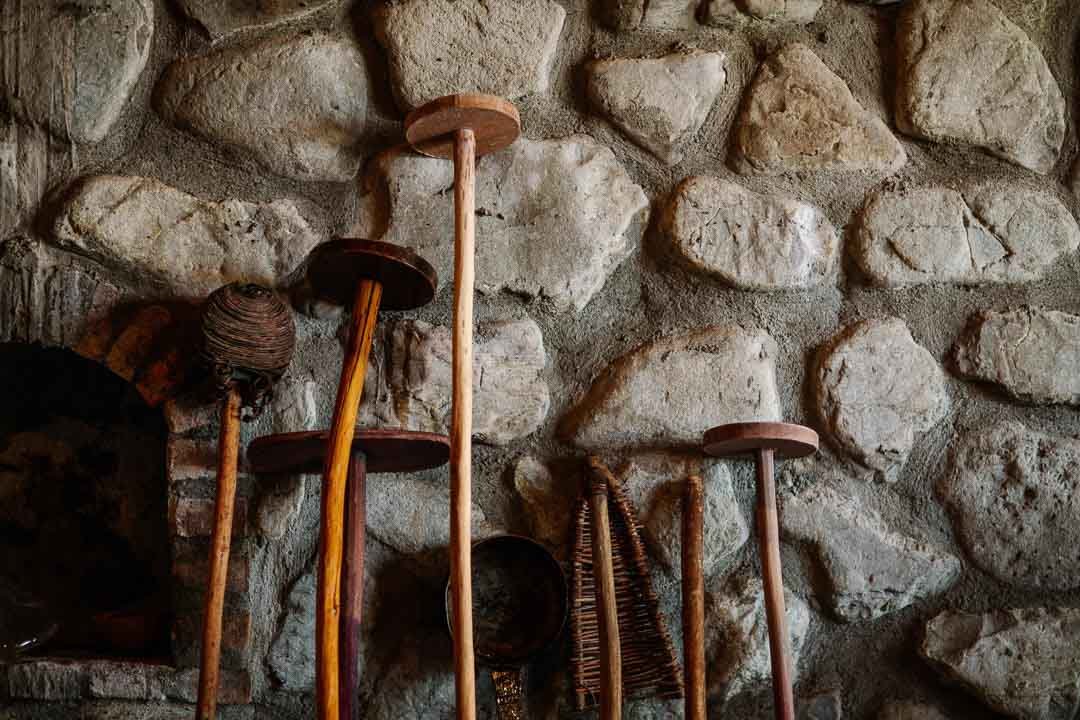
The use of qvevri is the traditional method for winemaking. The process is multi-step. First, the qvevri is cleaned by someone climbing in it, scrubbing it with very special tools made just for it, and then rinsing it with an alkaline solution several times. Next is the crushing. The sorted grapes are crushed in a stone or wooden wine press, then loaded into the qvevri, with either some or all of the skins, pulp, seeds and stems left depending on what type of wine they’re making.
Next is fermentation, in which no intervention takes place. They let it ferment naturally underground in these vessels which allow the temperature to be controlled naturally, for about 3 weeks most often. When fermentation is complete, they seal the qvevri with a lid and then seal that lid to prevent air from entering. The winemakers then leave it in the qvevri for 3 to 6 months to age. During this time, the yeast and the sediment settles at the bottom while the wine circulates above. The liquid is in layers as well, of which the best wine rises to the top. When it’s ready and reaches full maturation, the winemaker either bottles it or transfers it to another qvevri to store it short-term for their supra and personal use.
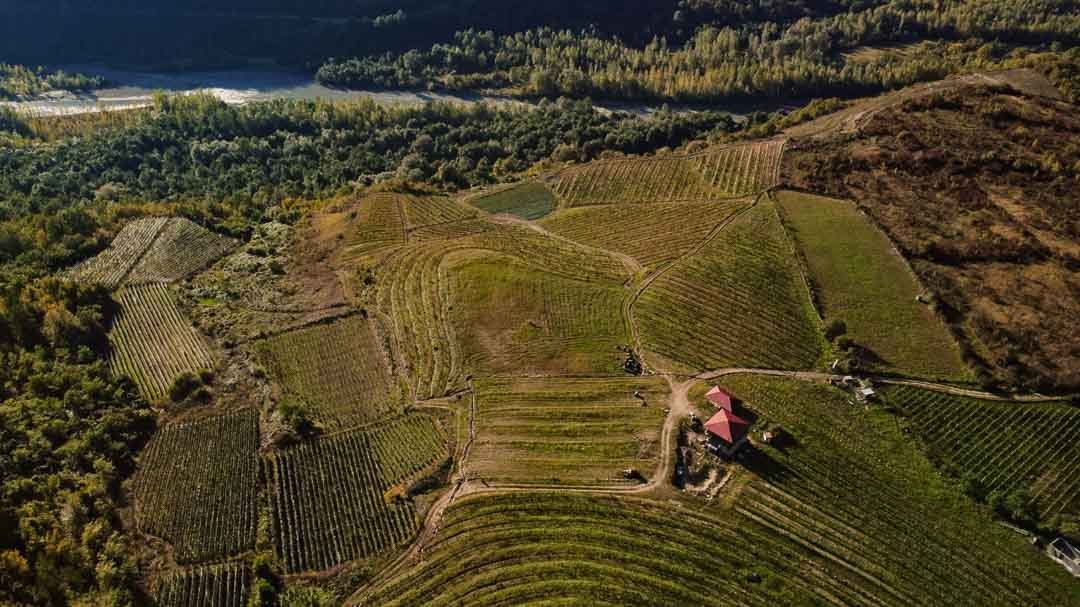
Georgians are hospitable people who love community and connection, so they often have supras. A supra is a traditional, often extravagant, celebratory meal that is at the center of their life. They could be celebrating a birthday or anniversary, or just hosting someone in their house, really, any excuse to have one.
This feast is filled with a climatic experience of delicious dishes and wines, herb salads, roasted meats, bread and spreads, the traditional khachapuri, sweets, and more. Georgia’s national dish, Khachapuri, is a hot bread that’s filled with melted cheese in the center where you tear off the bread and dip it. At each supra, there are some family held dishes, but many universal dishes and rituals as well. One particular ritual is the tamada or toastmaster, who sets the theme and agenda for the supra, and who also leads the toasts. First the tamada begins with their own trio – one to motherland, one to God, and one to guests, followed by another toast with each new round of delicious bites and sips, followed by guests answering back with toasts according to the theme.
Georgia is a wonderful country to visit any time of year, but if you want to be there for the grape harvest time, go in September and October. You will get to see the whole working process during harvest time. There is also a large Georgian festival to celebrate. During harvest season, depending on which grape variety is being used, that will determine exactly when it will be ready. One must be ready in a moment’s notice during this time. When it’s time, it’s time. And at this time, the whole country is harvesting. One winery I spoke with said they need more than 100 workers, sometimes 200, to harvest it all in time. And as soon as the grapes are off the vines, the clock starts ticking. Within 30 minutes to 1 hour of a grape being juiced, it starts fermenting. Because of this, transportation and keeping grapes intact is absolutely critical to prevent losing any of the precious harvest.
Though winemaking is such an ancient and uninterrupted tradition, they are not stuck in history. Producers not only use the traditional method, but they are also experimenting with new modern winemaking practices as well as experimenting with different types of indigenous grapes. After all, they have 500+ known varieties available. Some new techniques are using stainless steel tanks or oak barrels, adjusting the amounts of stems in the mix or length of time that they keep them in the vat. And with a plethora of grape varieties, they can please every taste.
While attending the expo, I got the chance to speak with a few of the wineries and learn more about their particular wines, methods they use, and have a bit of a taste. Exhibiting at the expo at the Wines of Georgia booth were 12 different wineries. My first stop was Ambrosia Winery which was started by a group of three international friends who had met in Paris originally while studying. French-Colombian Marie-Claude Marson, Italian Marta Imeneo, and American Maria Pangalos wanted to create wines that were easy to drink, feminine, and light just like their all-female, Gen Z winery. They connected with Georgian winemaker Olga Akulashvili who caught their vision, and soon their quest to produce wines began. Though they use the classic Georgian grape varieties, they searched and created differentiated wines that are filled with their international identities and ancient Georgian winemaking authenticity. They are feminine, light, airy, soft, elegant, and a perfect blending of variations, just like they are.
Even their label reflects this philosophy. While visiting an old bathhouse, they saw a beautiful mosaic that was a picture of Ambrosia. It was the nymph Ambrosia drinking wine, also known as ambrosia which was the term that meant the fruit of the gods. On every bottle lies a portion of this mosaic shaped in the contour of Georgia. Their method is more of the European method using stainless steel and performing intervention through decisions in filtering, changing the yeast to change the aromas, deciding whether to add sulfites or not, all in their search to create beautiful wines that are easy to drink, full of aromas, feminine, and again, just like them. Their Mtsvane & Rkatsiteli is a unique blend that is crisp and refreshing, while their Saperavi is full bodied in the ruby red appearance that Saperavi is so well known for. My final taste was of their amber variety, the Kisi and Chardonnay, that’s made in the traditional qvevri, full of its distinct texture.
My next stop was at Chelti Winery where I spoke with Co-Founder and Commercial Director Ana Mirianashvili. Now Chelti Winery’s story is one of true, authentic Georgian culture, of family, tradition, and deep roots. It’s a five-generation legacy of winemakers that unfortunately was disrupted when the Soviets came in. After a temporary detour, the family was back to their roots and cellar in 2001, revived by Giorgi Mirianashvili. Together, the family has over 100 years of expertise, making their wines stable, highly developed, and always pleasing. Having over 80 hectares, they produce award winning wines using a mix of traditional qvevri method which gives the authentic taste, as well as modern methods including stainless steel and oak barrels.
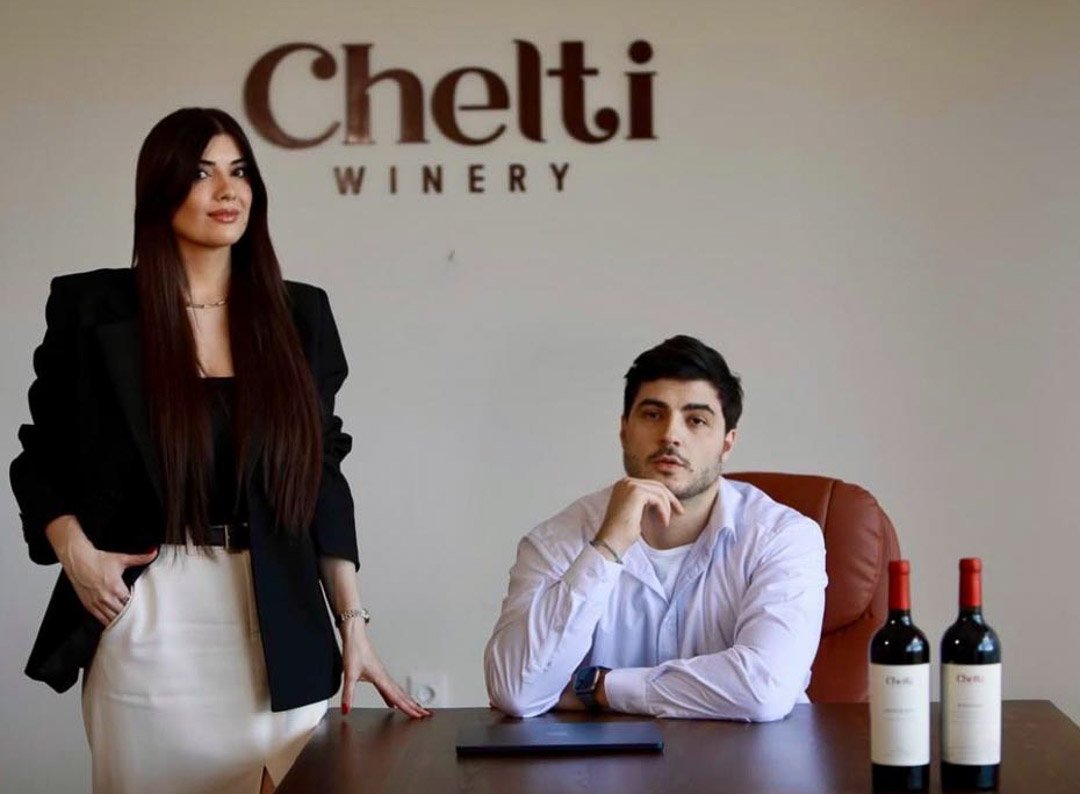
They also have a wine tourism complex on their estate for you to enjoy their variety. Set in the unique microclimate where mountain slopes, iron clay soil and volcanic stones merge and are enriched by the rare elements there, the vineyards produce exceptional wines that are bold and balanced. Along with this unique land, they have a wine storage vault 25 feet below ground, which houses the largest reserve stock of Saperavi in Georgia. Offering a wide variety of wines that they produce including their Family Collection and Heritage Collection, they have something for everyone. Whether you’re looking for a white, amber, rose, red, or chacha spirit, you will find a history-meets-modern symphony of flavors that will surely delight your taste buds.
Badagoni was my next stop on my mini tour. Spanning a total of 500 hectares over every microzone in the Kakheti region, their winery produces 13 million bottles per year and exports to over 35 countries. Their mission is to be true to the Georgian heritage and its legacy of winemaking, to protect that precious tradition, while being innovative for today’s culture. Some of the more modern methods include the use of specialized microfiltration and bottling systems that were designed exclusively for Badagoni by renowned Italian companies Bertolaso and Enotec, using stainless steel fermentation tanks, and using American, French, and Slovenian oak barrels. Aging from 9-36 months and using different varieties of oak barrels allows each wine to develop in complexity, aroma, depth and balance. Their vineyards are meticulously and vigorously controlled and assessed.
One very interesting aspect and distinction of Badagoni is their contribution and support in restoring the Alaverdi Monastery. Georgia’s religion, Orthodox Christianity, is very special to the country, in fact, it’s the heart of it. On your journey throughout Georgia, you’ll find monasteries dotted all over the country. This particular monastery dates back to the 9th century and has been restored with the help of Badagoni. Beneath the ground was discovered their 11th century wine cellar holding 40 qvevri. Badagoni’s qvevri wine is produced in these very vessels, preserving their rich culture, and allowing you to taste the history and deep roots of Georgia.

Assisting with the growth of wine tourism in Georgia is also an important pillar in their philosophy and vision. They have three hotels to stay at and four restaurants to enjoy while you’re touring the plentiful vineyards. They have helped the expansion of wine education as well with initiatives like “Qvevri Academy”. At the center of all of these components, lies their message and vision, to take you on a journey where the rich heritage, traditions, and devotion of Georgia are merged with an innovative future.
There are so many wonderful wineries in Georgia, and this is just a small few radiating the amazing history that you will taste when you visit Georgia’s vibrant wine terroirs. Though every story and every winery’s vision is different, one thing is always front and center, protecting and sharing the 8,000-year history of tradition and ancient practices of winemaking woven together with today’s modern technologies and methods to bring you their best family wines from this beautiful fertile ground.
With a rapid increase in tourism in Georgia, travel there has become highly desirable causing hotels to spring up everywhere. Tbilisi, the capital of Georgia, is a modern city with an abundance of activities. There are museums to attend, festivals to enjoy, and beautiful monasteries and churches to view. After all, religion is very important to Georgians. It has wonderful luxury and boutique hotels to stay at for a few days or longer. Or take in nightlife, which is similar to Berlin. You can enjoy an array of climates and experiences, from the wonderful seaside to skiing at premier ski resorts in the Caucasus. And definitely, make sure to take a wine tour and explore their vast regions and wineries to discover all the beautiful sights, traditions, and culture that Georgia offers. Go on a guided tour to make sure you don’t miss any of the not-so-easy to locate wineries and have your experience to the fullest. The National Wine Agency organizes wine tours throughout the year, has excellent travel resources, and English-speaking guides to help close any language gap.
Wondering where you can buy Georgian wine? Or looking to go on a winery trip to Georgia? Talk to your favorite restaurants and liquor stores about carrying Georgian wine, the first winemakers, and encourage them to carry it. Check out www.winesgeorgia.com for the list of wineries and what retailers carry them, as well as find invaluable information including flights, hotels, tours, and restaurant recommendations, and helpful tips for visiting Georgia’s wineries. For more information on Vinexpo Americas or their other expos and experiences;
Vinexpo Asia, Vinexpo Explorer, Vinexpo India, WBWE, Wine Paris, Be Spirits, and Be No, you can visit www.vinexpo-americas.com/newfront or www.vinexposium.com. And of course, don’t miss out on next year’s Vinexpo Americas coming back to Miami in 2027.

With a fashion buyer grandmother and Mack Sennett Studios producer as a great grandfather, Dana’s love for Old Hollywood and fashion ignited. Sparking wonder, accentuating one’s being, helping them reach their potential, and knowing how valuable they are is always central to everything she does.
Get the latest fashion, culture, and art updates, including magazine releases release parties
Sponsored Content

